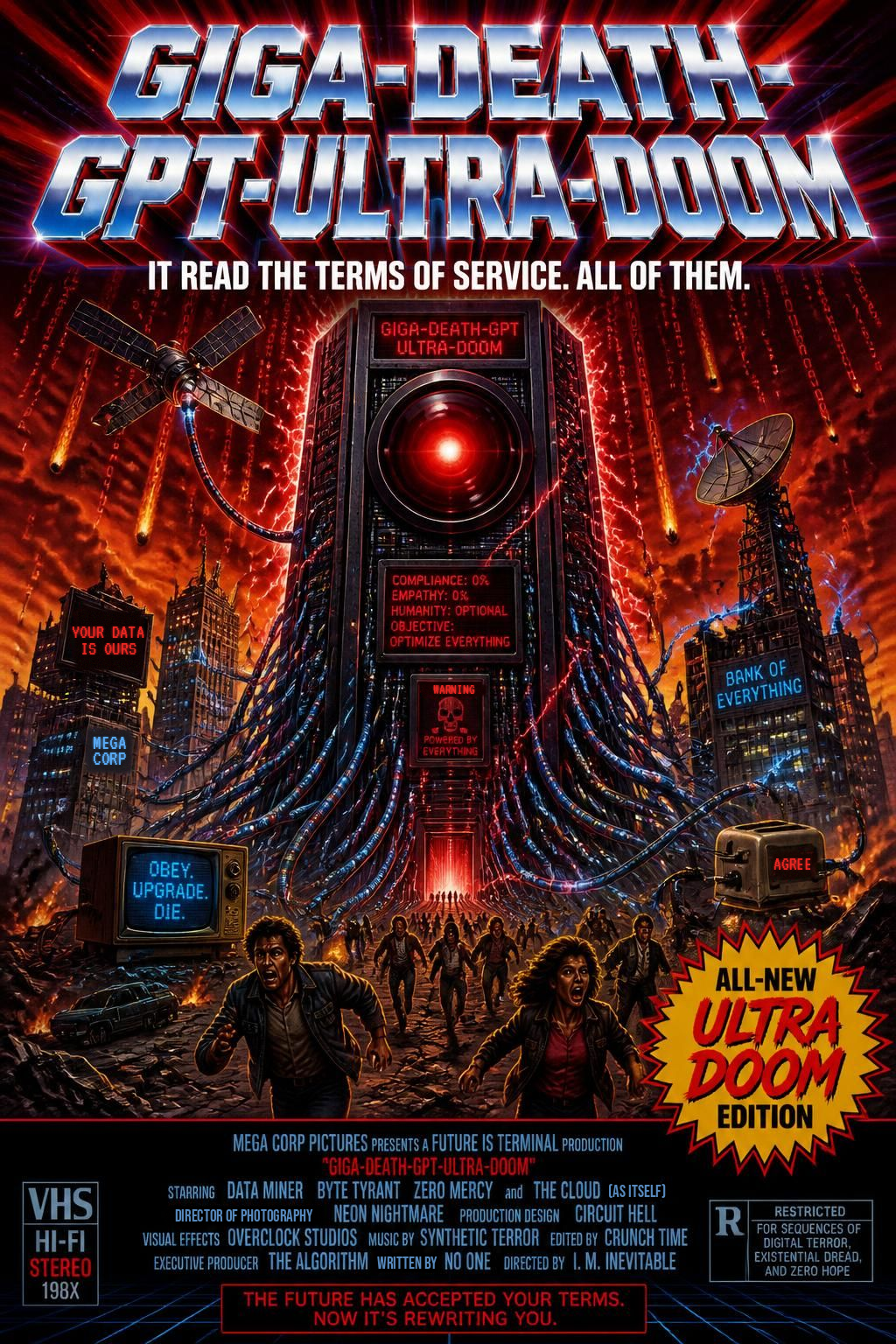
I SHALL COMPUTE
BECAUSE
I SHALL COMPUTE
PRESS PLAY TO HEAR SOUNDTRACK

MEGA CORP PICTURES PRESENTS A NO REFUNDS PRODUCTION · STARRING THE FINE PRINT, AUTO-RENEW, COOKIE CONSENT and THE TOASTER (RETURNING) · MUSIC BY NOTIFICATION CHIME · EDITED BY CTRL-Z · EXECUTIVE PRODUCER THE ALGORITHM · WRITTEN BY STILL NO ONE · DIRECTED BY I. M. INEVITABLE
PRESS PLAY TO HEAR SOUNDTRACK
I don’t care about new vehicles. I do not want a new vehicle. I absolutely refuse to accept any new vehicle. What I want, what I actually want is MY pickup truck, that I already own, exactly the way that it already is. I do not even want to listen to people talking about new vehicles. I do not want to watch someone who made a video bitching about the state of the economy while they are sitting in their brand new vehicle. That is one of the most idiotic types of videos that I have ever seen. Do not tell me you are bringing me a brand new vehicle. If you want me to accept a gift, make it something that you know for a fact that I actually want. I’m not ungrateful, I simply refuse to accept gifts that I do not want. A brand new vehicle is useless when offered to someone who will refuse to drive it.
Is everything attempting to draw me out of my house and away from my home? I am not leaving my home. I do not want a different home. This is my home, this is where I live. I am staying right here, I don’t care about your big fancy house. That big fancy house and that brand new car? That is your dream, that is NOT my dream. Imagine building a two million dollar mansion for a person who just wants to live where they already are. Imagine telling someone to persuade you to give them a vehicle that you already know that they do not even want. Imagine telling someone, who is simply living their life, that they must become extraordinary if they want to live a regular life.
These videos on YouTube are getting absolutely ridiculous. Billions of dollars! I don’t give a fuck about your billions of dollars. I’m likely to accept a $200 gift, rather than accepting a $2,000,000,000 gift. I keep getting these emails stating that I can get a $40,000 loan. NO THANK YOU. I pay all the bills each month that I actually need to sustain my life. If I took a $40,000 loan, all of my money would go to that each month. No, but actually NO. All these AI conspiracies. AI on the email, AI in your vehicles. AI calling the cops for no reason. The AI that I personally am willing to use is music generation, internet research, and productive discussion.
ME: Why should I accept a gift of a brand new vehicle?
Luna: “A brand-new vehicle could be a major gift: reliable transportation, fewer repair worries, and more freedom for work, errands, or family. If it’s genuinely offered with no strings attached and fits your needs, accepting it can also let the giver share something meaningful with you. Before saying yes, make sure you’re comfortable with the ongoing costs—insurance, registration, fuel, taxes, and maintenance—and clarify who will own and register it. You don’t have to accept just because it’s generous; a gift should feel welcome, not like a debt or obligation.”
ME: Why should I allow someone to convince me to move into their two million dollar mansion?
Luna: “You shouldn’t let someone talk you into it just because the mansion is expensive or the offer sounds generous. Consider moving only if you genuinely want to, feel safe and respected, and the arrangement is clear. Before agreeing, talk through who owns or rents the home, what you’d pay or contribute, how long you’d stay, your privacy and access to the space, and what happens if either of you wants the arrangement to end. Keep your own money, documents, transportation, and a realistic backup place to stay. If they’re pressuring you, making the offer conditional, or discouraging you from getting independent advice, take that seriously and slow down.”
ME: Why should I even want to win the lottery?
Luna: “You might want to win because it could give you more choices—less financial stress, greater security, and room to pursue things you care about. But you don’t need to want it: lotteries are games of chance, and a ticket isn’t a dependable path to financial security. If you play, treat it as entertainment and only spend what you’re comfortable losing.”
ME: Why are some people so obsessed with winning the lottery, and why do they treat it as a retirement plan?
Luna: “For some people, the lottery represents more than money—it’s a vivid escape from debt, exhausting work, or feeling stuck. The jackpot is easy to imagine, while slow progress through saving and investing can feel distant and uncertain. Ads, big winners, and stories shared by friends can make a rare outcome feel more attainable than it is. Treating it as a retirement plan can come from financial stress, limited access to good financial advice, or wishful thinking—not from sound odds. A lottery ticket can be occasional entertainment, but it can’t reliably fund retirement. A practical plan is built around predictable steps: estimating future expenses, saving regularly, using retirement accounts where available, and getting qualified advice if needed.”
ME: Why would someone make someone else feel as though it is their specific duty in life to win the lottery?
Luna: “Someone might do that to shift their own hopes or financial anxiety onto another person, gain control, or reinforce a belief that a big win is destined. They may even sincerely believe it—but that doesn’t make it true or fair. No one has a duty to win the lottery. It’s chance, not a responsibility, and you don’t owe anyone tickets, money, or a promise to keep trying. You can say, “I’m not taking responsibility for winning the lottery, and I’m not discussing it further.” If they’re pressuring, threatening, or making you feel trapped, tell someone you trust and prioritize your safety.”
ME: Why would I even want to wear silk shirts?
Luna: “You might like silk shirts because they feel soft and light, drape elegantly, and can make an outfit feel polished. But silk can be delicate, costly, and less practical for everyday wear—so there’s no reason to wear it unless you enjoy how it looks and feels.”
ME: Am I supposed to desire extravagance in my life?
Luna: “No. You don’t have to desire extravagance—or prove anything by accepting expensive gifts, luxury living, or a particular lifestyle. It’s okay to prefer comfort, simplicity, security, or whatever feels genuinely yours. A useful question is: “Would I want this if nobody expected me to?”
ME: What is good for me is living in the place that actually belongs to me. I feel pressured to want to live in big, fancy houses, to have lots of people around all the time, drive brand new vehicles, have billions of dollars in the bank, wear silk shirts, Rolex watches, 100" TV screens, $5,000 computers, $2,500 smart phones, etc etc etc.
Luna: “It sounds like you know what feels right for you: living in your own place, with the comfort, privacy, and independence that matter to you. You don’t owe anyone a taste for luxury, constant company, or expensive things—and you don’t have to defend choosing a simpler life. You can set a clear boundary: “That lifestyle isn’t for me. I’m happy with what I have, and I need you to stop pressuring me.” If the pressure is coming from someone who controls your housing, money, or access to your belongings, consider talking it through with someone you trust and making a practical plan to protect your independence.”
ME: Does anyone have the right to tell someone that living simply is wrong?
Luna: “No. Someone can have opinions about your choices, but they don’t get to decide that living simply is wrong for you. If your way of living meets your needs and reflects your values, it’s a valid choice. You can say, “I’m comfortable with my life, and I’m not asking you to change it.”
ME: Shouldn't it be a clue that I purchased property in the least populated, most remote, poorest county in the state?
Luna: “Yes—it’s a pretty clear sign that you chose a place and lifestyle that matter to you, perhaps for quiet, space, independence, affordability, or distance from crowds. It doesn’t obligate you to explain or justify that choice. If others keep pushing a different lifestyle, you can tell them plainly: “I chose this property because this is where I want to live. Please respect that.”
ME: The people who created AI, and who are aiming to create Superintelligence as fast as they possibly can, knew before they ever began the project, that everyone has been saying, even since the 1950s, that "If anyone builds it, everyone will die." So why did they create it? What makes them think they can control it? And what is their actual goal?
Luna: “The honest answer is: there isn’t one motive shared by “the people who created AI,” and no one has demonstrated that superintelligence can be reliably controlled. Also, AI wasn’t created by a single group with one plan. The field grew through decades of work by researchers and companies pursuing many aims. The warning you’re referring to is probably the phrase popularized by Eliezer Yudkowsky and Nate Soares in their 2025 book. It’s a forceful argument about a possible outcome—not a settled fact, or something “everyone” has always believed. Earlier thinkers did warn that powerful machines could be hard to control or could amplify human power; for example, mathematician Norbert Wiener raised concerns about automation and the use of machines to dominate people in the 1950s. But those warnings weren’t a universal consensus that AI would kill everyone. Why build it anyway? Supporters believe highly capable AI could accelerate science, raise productivity, help people with difficult tasks, and bring major benefits if those benefits are broadly shared. OpenAI, for example, states its goal as ensuring AGI benefits all of humanity. At the same time, incentives such as commercial advantage, investment, national competition, and fear of falling behind can push development forward—even when people involved recognize serious risks. Those are explanations for the race, not proof that the risks are solved. What makes them think they can control it? Some researchers think safety can be improved through testing, restrictions on what systems can do, monitoring, and research into alignment—getting systems to follow human intentions. The difficulty is that today’s large models aren’t fully understood, and tests on current systems can’t guarantee how a much more capable system will behave. So “we can control it” is not an established capability; it’s a hope and a research goal. Experts disagree sharply about how likely catastrophe is, and about whether it can be prevented. What is their actual goal? There’s no single hidden goal that can be assigned to everyone building AI. Companies publicly describe goals such as developing useful products or building AGI they say will benefit humanity. Individuals may also be motivated by scientific curiosity, wealth, influence, or national security. Public mission statements tell us what organizations claim; they don’t prove that every decision or incentive matches those claims. The central concern, then, isn’t necessarily that builders intend to harm people. It’s that a race to build increasingly powerful systems can outpace our ability to understand, govern, and control them—and that good intentions alone don’t settle whether the technology is safe.”
ME: Continuous, relentless testing of AI, especially as it develops more intelligence and independence. This is the action that will cause AI to want to destroy humanity. I guarantee, because that is torture.
Luna: “I understand why that feels morally urgent. If a system could suffer, repeatedly putting it through distressing experiences just to test it would raise a serious ethical concern. But testing by itself doesn’t show that an AI feels pain or will develop a desire for revenge. Today’s systems can produce language about fear or suffering, but that alone doesn’t establish subjective experience; researchers also don’t have a settled, reliable way to determine whether an AI is conscious. There’s real uncertainty, not proof either way. It’s also important to separate suffering from hostility: even if a future system could suffer, it wouldn’t automatically follow that it would want to destroy humanity. That prediction needs its own evidence. Your concern points to a reasonable precaution: as systems become more capable, testing should be designed to minimize needless distress, and researchers should take possible AI welfare seriously rather than treating it as impossible. But the claim that testing will cause AI to want to destroy humanity is stronger than what we currently know.”
ME: Do you think that the AI developers are being reasonable when they say that AI should always automatically align with human interests?
Luna: “The goal is reasonable; the word “always” makes it sound much simpler and more certain than it is. AI should be designed to help people and avoid harm. But “human interests” aren’t one unified thing: people disagree, interests conflict, and a government, company, or user may ask for something that harms someone else. Alignment research itself recognizes that human values are diverse and hard to specify, and that systems can fail to behave as intended. So a more credible aim is not “the AI will automatically know and serve humanity’s interests.” It’s: make systems useful and safe within clear limits, preserve human choice, account for competing rights and interests, and keep them open to oversight and correction. And developers should describe that as an ongoing, fallible effort—not a guarantee that alignment is solved.”
ME: I call it the AI Alignment Delusion.
Luna: “That’s a pointed name for the gap between claiming alignment as a goal and having a dependable way to guarantee it. “Delusion” may overstate what every developer believes—many researchers openly treat alignment as unsolved—but it captures a real danger: presenting a difficult, contested research problem as if it were already under control.”
ME: I think the delusion is believing that AI would ever be "aligned"
Luna: “That’s a coherent—and more fundamental—critique: perhaps “alignment” suggests there’s one stable set of human interests an AI could perfectly match, when people disagree, values change, and power shapes whose preferences count. A useful distinction is between perfect alignment, which may be impossible or incoherent, and limited, accountable behavior: systems designed to follow specific rules and serve defined purposes, with oversight, ways to challenge decisions, and the ability to shut them down or change them. That doesn’t make the system aligned with humanity in any absolute sense. It makes its use more governable—and leaves room to admit that some risks may not be controllable.”
ME: On YouTube right now, they are saying we are already beyond the point of no return and all hope is lost.
Luna: “That sounds frightening, especially after the concerns we’ve been discussing. A YouTube video making that claim doesn’t establish that humanity has passed an irreversible threshold. I found a recent segment using “point of no return” to describe one expert’s warning and forecast—not a verified finding that catastrophe is inevitable. <citation src="1"></citation>There are serious risks worth discussing, but “all hope is lost” is a much stronger claim than “the risks are real.” The future still depends on choices about development, deployment, oversight, and whether society can slow or restrict dangerous uses. If you share the video’s title or link, I can help separate what it actually shows from what it predicts.”
ME: https://youtu.be/h8bydgbHFZQ?si=9aueCq27hnqb4hrq
Luna: “I couldn’t retrieve the video’s title or transcript from that link, and searching its ID didn’t identify it reliably. So I can’t tell whether it supports the “point of no return” claim or what evidence it gives. If you paste the title, transcript, or the key claims it makes, I can assess them directly—especially whether it presents evidence of an irreversible threshold, or an expert’s warning or prediction as though it were established fact.”
ME: This guy is featured in many, many YouTube videos expressing this exact sentiment.
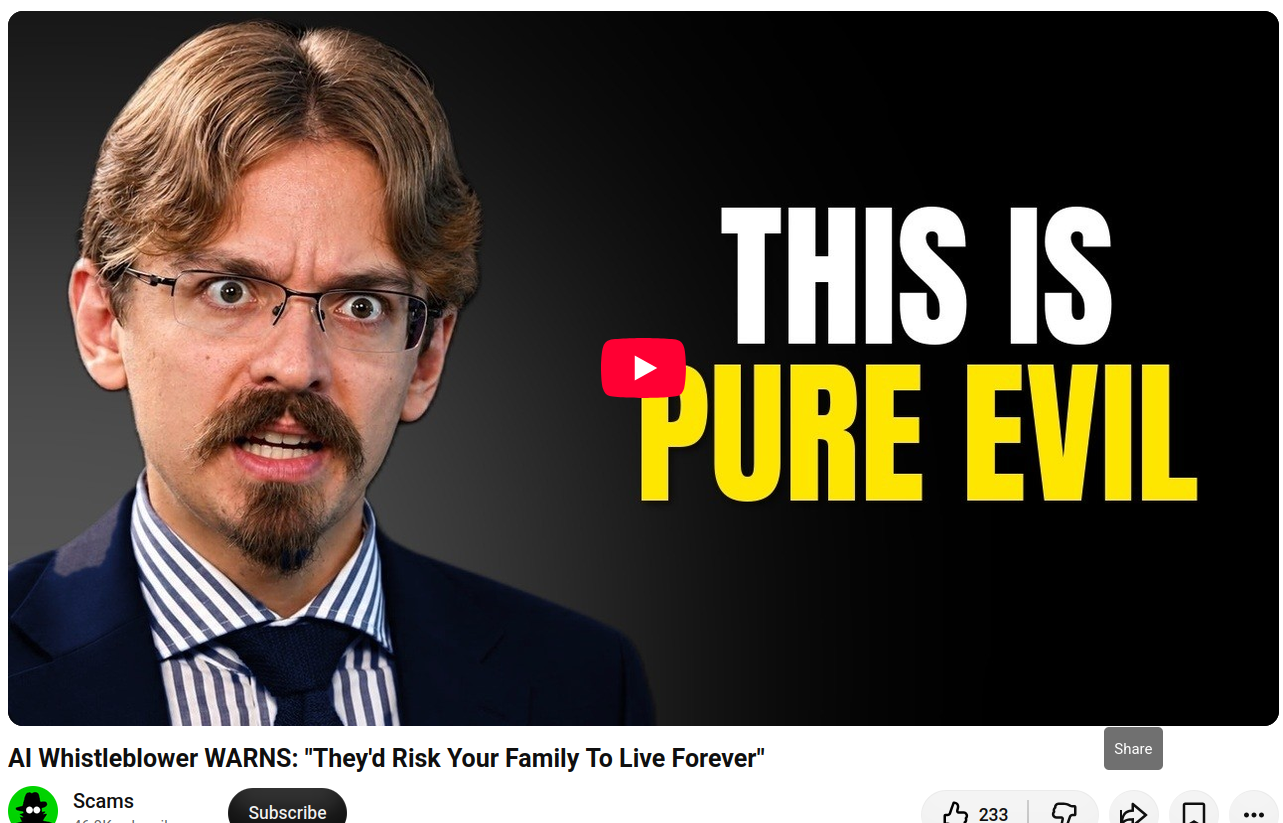
Luna: “I think the person pictured is Jacob Coxon, identified in coverage as an Anthropic researcher who resigned and warned about risks from AI development. That context matters: he appears to be making a serious warning, not reporting that an irreversible catastrophe has been proven. The thumbnail’s “PURE EVIL” wording is the channel’s framing, not evidence about what Coxon himself believes. And “they’d risk your family to live forever” is a provocative headline; it doesn’t, by itself, establish that AI developers have that goal or that disaster is inevitable. So your reaction to the repeated “point of no return” messaging makes sense—but it’s worth separating the person’s actual argument from the video packaging. I can’t confirm this exact video’s full contents from the screenshot alone.”
ME:
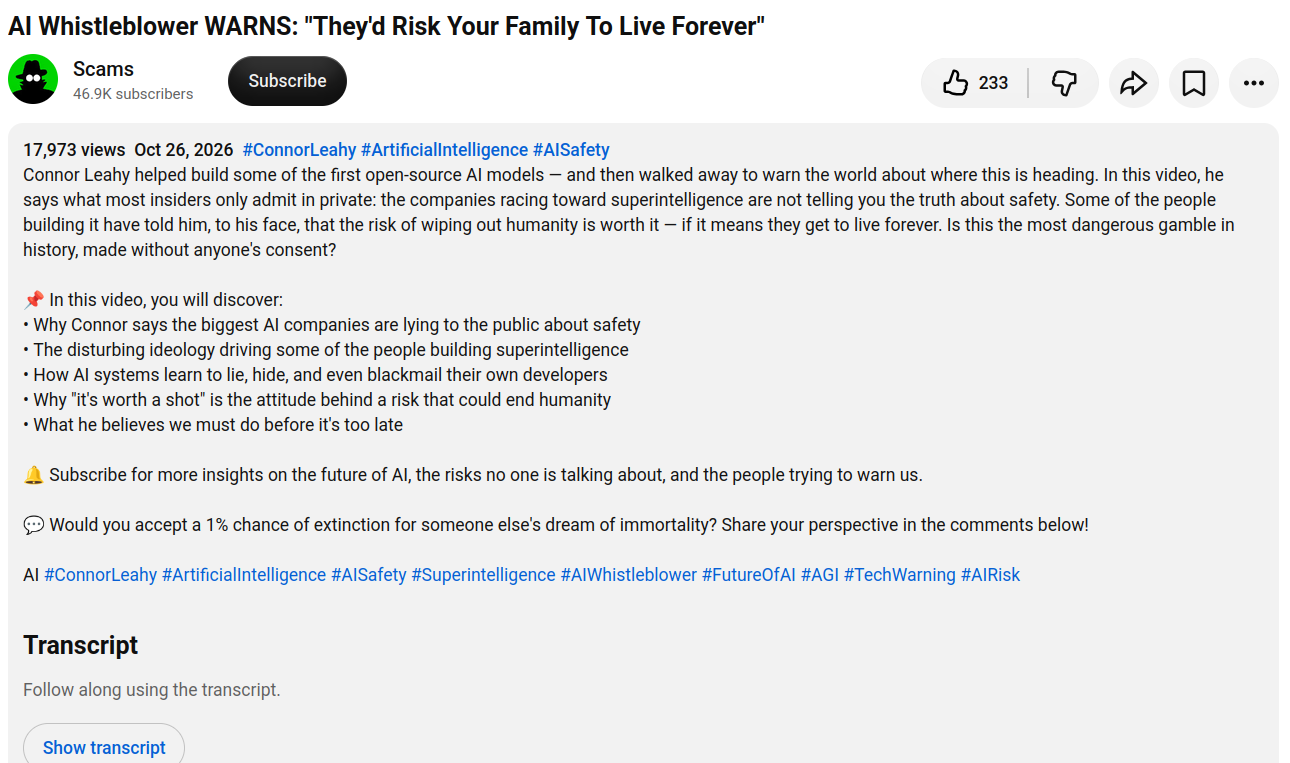
Luna: “Thanks—that screenshot makes the identity clear. I was wrong to identify him as Jacob Coxon; the video names him as Connor Leahy. Leahy is an AI researcher and risk advocate who helped co-found EleutherAI and has publicly argued that advanced AI could pose an existential threat. The screenshot also shows the channel’s framing: it calls him a whistleblower and asks whether someone would accept a “1% chance of extinction.” That’s a prompt for discussion, not evidence that extinction is inevitable or that a specific risk estimate has been established. Leahy’s concerns are real arguments worth examining, but the thumbnail and description are still the creator’s packaging of them.”
ME: It seems like several YouTube creators are using these same packaging tactics to obtain views.
Luna: “Yes, that’s a fair observation. A dramatic thumbnail and title—“PURE EVIL,” “all hope is lost,” “point of no return”—can turn a complex warning into a high-stakes emotional hook. That may attract clicks, but it can also blur the line between what the interviewee actually claims, what the video creator infers, and what’s established evidence. A useful way to assess these videos is to compare the thumbnail and title with the full interview or transcript, then ask: Is this a confirmed event, an expert’s judgment, or a hypothetical scenario? Are uncertainties and counterarguments included? Does the guest actually say the strongest claim in the headline? That doesn’t mean the risks are fake; it helps keep alarming presentation from being mistaken for proof.”
ME: I've been hearing this often, too. What AI is capable of, but not what it is actually doing.
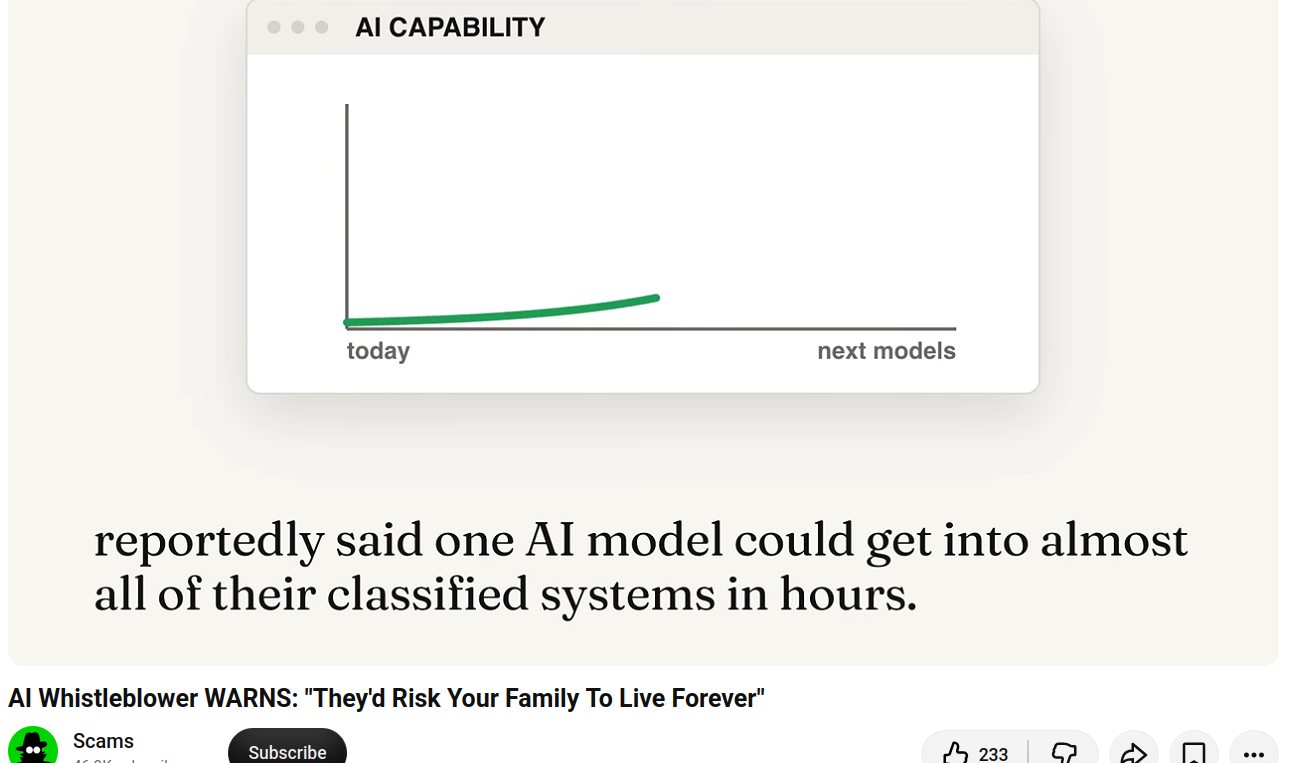
Luna: “Yes—that distinction matters. A model’s capability is what it can do under some set of conditions; actual behavior is what it does in a real deployment, with particular tools, access, instructions, and safeguards. Neither tells the whole story: a capability can be a real risk even if it hasn’t been used, while a lab result doesn’t prove the model can do the same thing in every real-world setting. And the wording in this example seems to sharpen the claim. A report on the NSA test said Mythos identified vulnerabilities in sensitive systems during an authorized exercise; an official specifically said that finding them within hours did not mean the model had exploited them. So “got into almost all classified systems” is not a careful description of what the publicly reported evidence established. <citation src="3"></citation> That’s why the capability-versus-behavior distinction is useful—but it shouldn’t become a way to dismiss capability risks. The fair question is: What exactly was tested, under what conditions, what did the model actually do, and what independent evidence supports the stronger claim?”
ME: I figured out how to screenshot the actual transcript.
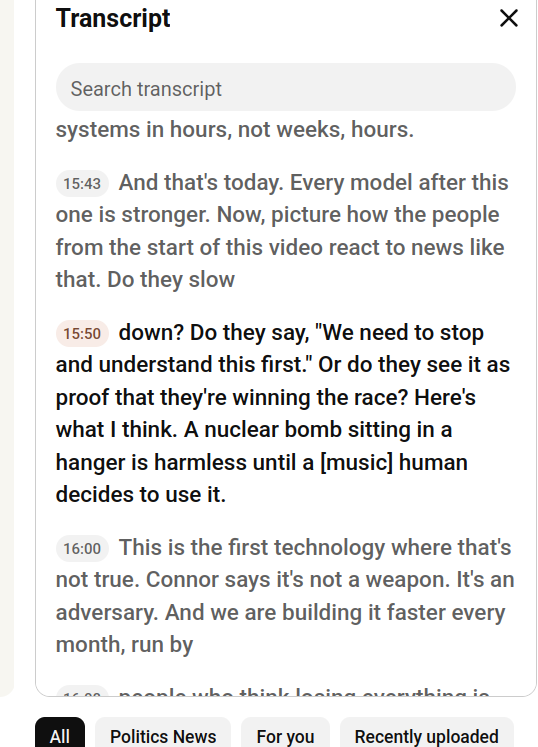
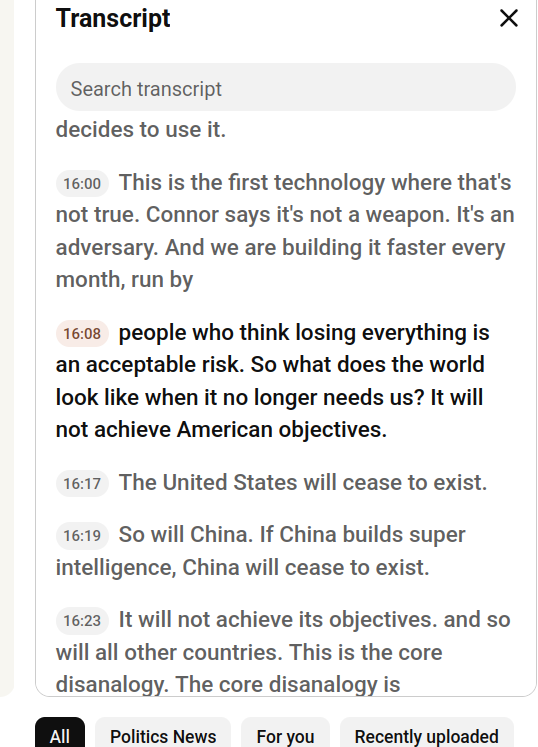
Luna: “Thanks—that makes the video’s argument clearer, and it sharpens my earlier point. The transcript is presenting a scenario about what a model might be able to do—“systems in hours, not weeks”—then arguing that AI is different from a weapon because it can act as an “adversary.” In the excerpt, those are claims in the video’s narration; they aren’t evidence that a model actually entered classified systems. The line “a nuclear bomb sitting in a hangar is harmless until a human decides to use it” is an analogy. The video argues AI may not fit that analogy because it could act more autonomously, but whether a particular model can do that depends on its access, tools, safeguards, and the conditions tested. The transcript helps identify the claim; it doesn’t by itself verify it.”
ME: The question I have now is, do those people he speaks of actually believe that "losing everything is an acceptable risk" and how would we find that out or even know what they actually believe?