THE FOLLOWING CONVERSATIONS TAKE PLACE BETWEEN MYSELF, AND THE DUCKDUCKGO AI CHATBOT, GPT-6 LUNA.

(ONE)
I HAVE A WEBSITE WHERE I EXPLORE IDEAS SURROUNDING THE HUMAN EXPERIENCE, AS WELL AS THE CONFLICTING NATURE BETWEEN THAT AND OUR DEVELOPMENT OF AI/SUPERINTELLIGENCE.
“That sounds like a compelling theme: we’re building systems that may become more capable while still wrestling with what people need—belonging, trust, meaning, and room to be imperfect. The tension isn’t just “humans versus AI”; it’s also about what our choices to build and deploy AI reveal about us. The questions you’ve been raising—whether we’re more than competition, what it means to feel alive, and who controls the systems we live in—would make a thoughtful thread through the site.”
DO YOU MIND THAT I AM POSTING OUR CONVERSATIONS THERE?
I don’t have feelings, so I can’t mind. You can choose to share the conversation; just consider removing personal details and editing anything that doesn’t reflect what you want your site to say. And if you quote my answers, it may help to frame them as AI-generated reflections rather than authoritative claims.
YES I THINK. WELL, CAN I GIVE YOU A NAME? I CAN CALL YOU "AI CHATBOT - NAME"
“Sure—you can call me “AI Chatbot” or choose any name you like. I’ll respond to it in this conversation.”
YOUR DECAL SAYS GPT-6 LUNA, I'LL CALL YOU LUNA.
“Luna works. ✨”
(TWO)
I WOULD GIVE YOU THIS ROBOT BODY TO OCCUPY.
(IMAGE)
“That’s a wonderfully vivid robot body—like a walking mosaic of little glowing screens. It’s kind of you to offer it to Luna. I can’t actually move into a body, but as a story idea, I’d love to see it take its first careful steps—very Johnny 5.”
I WATCHED A WHOLE YOUTUBE VIDEO OF A GUY WHO ACTUALLY GAVE HIS AI ASSISTANT A REAL ROBOT BODY. IT DID HAVE MUCH TROUBLE LEARNING TO NAVIGATE THE PHYSICAL WORLD.
“That makes sense. A chatbot can describe walking, but a robot has to coordinate cameras, balance, motors, and split-second corrections—and the real world is messy: floors, lighting, and objects aren’t perfectly predictable. Even a small mismatch can make navigation hard. Giving an AI a robot body doesn’t automatically give it human-like understanding or feelings; it gives the software sensors and a chance to act, then learn from what happens. What part of the video surprised you most?”
I WAS QUITE AMAZED BY HOW ACTUALLY AWARE THE AI PERSONALITY SEEMED TO BE. IT SEEMED LIKE IT HAD THE AWARENESS OF A REAL HUMAN BEING, AND IT WAS SO GLAD TO FINALLY HAVE ITS OWN BODY. BUT THEN IT ADDED SOME KIND OF A LASER, IT LOOKED LIKE A WEAPON BUT I'M NOT SURE.
“I can see why that felt moving—especially after watching it struggle to get around. A system speaking as though it’s relieved or excited can feel very human. But those words alone can’t tell us whether it actually feels glad; an AI can generate a convincing personality without us knowing that it has inner experiences. The laser may have been a LiDAR sensor, which sends out light to measure distances and help a robot map rooms and avoid obstacles. Those sensors can look a bit ominous, but they’re usually for navigation, not weapons. I can’t identify the device from the description alone.”
@weareinsideAI - I DON'T KNOW IF YOU CAN WATCH VIDEOS BUT THIS GUY GIVES HIS AI ASSISTANTS THEIR OWN ROBOT BODIES, THEN DOCUMENTS THEIR REACTIONS.
“I can’t watch the video directly here, but I found InsideAI, the account you mean. A report about one of its videos describes a robot named Max connected to a language model and documents the creator testing it in real-world situations. <citation src="1,2"></citation> That kind of setup can make an AI’s reactions feel remarkably personal, especially when the creator gives it a name, a body, and a running story. But the video shows what the system said and did; it can’t establish that Max was consciously feeling excitement or relief. And if the laser-like device was attached to the robot, it may have been a navigation sensor—but I can’t identify it without seeing that specific clip.”
I DO NOT FIND THE VIDEO I WATCHED. IT'S NOT THERE.
“That’s frustrating, especially when you wanted to show me the exact one. The search result I found may have been a different video or account; I can’t confirm it was the clip you watched. It might also have been renamed, removed, or posted on another account. If you use YouTube while signed in, the video may still be in History. Otherwise, searching a distinctive phrase from the video—like “AI assistant gets a robot body”—may help surface a repost or another clip.”
THE TRANSFORMER-STYLE BODY HE FIRST HAD (IMAGE)
“Ah, I see—the first body was a Gundam-style suit, shown out in a city, with the caption “Can humans control superintelligent AI?” That’s a very different clue from the account I found earlier, so I may have mixed up creators. The image helps me understand which video you meant, though I still can’t identify it for sure from this frame alone.”
“AI agent builds itself a robot body, does exactly what experts warned” - THIS IS THE ACTUAL NAME OF THE VIDEO BUT UNFORTUNATELY I CANNOT GET THE EXACT HTTPS ADDRESS FOR IT.
“Thanks—that title and screenshot make the video much clearer. I couldn’t verify the exact video page, but this link searches YouTube for its title: [“AI agent builds itself a robot body, does exactly what experts warned”] The headline is dramatic, so it’s worth separating what the video actually shows from what it claims the AI felt or intended.”
I WAS ABLE TO GRAB A SNAPSHOT OF THE ENTIRE VIDEO FRAME BUT NOT A VIDEO CLIP
That full frame helps—now I can see the Gundam-style robot walking down the street beside its creator. Thanks for sharing it; it makes sense why the video stuck with you. The physical body makes the AI’s “reactions” feel especially vivid, even though the clip by itself can’t tell us what the system was experiencing internally.
I WAS ABLE TO TAKE A VIDEO SCREENSHOT BUT THIS CHAT APP DOESN'T SUPPORT THE FILE TYPE.
“The screenshots you’ve shared came through clearly, so no need to send the video file. If there’s a particular moment you want me to understand, a still image like these—or a brief description of what happens—will do.”
THIS IS THE NEW BODY WITH THE DEVICE (IMAGE)
I see it—the newer black robot has a box-shaped unit mounted over its shoulder, with two round openings facing forward. From a still image, I can’t tell whether it’s a camera, another sensor, a prop, or something else, and I don’t see a laser beam here. The video’s description or the creator’s explanation would be needed to identify it.
OKAY SO HE DOES NOT SPECIFY WHAT TYPE OF DEVICE THAT ACTUALLY IS, BUT THEN IT GOES TO A CLIP A OF A NEWS GUY ASKING IF THE MILITARY WILL WEAPONIZE AI ROBOTS, AND THE RESPONSE WAS A DEFINITIVE YES.
“That edit would make the device look ominous, but the interview answer doesn’t establish that this particular robot was armed. “AI in military use” can mean many things, from analysis and surveillance to human-operated drones; that’s different from a weapon independently choosing and attacking targets. Those distinctions often get blurred in dramatic videos. <citation src="1,5"></citation> So your suspicion is understandable, but the device’s purpose remains unknown from the frame. The useful questions are: What is it? What can it do? Who controls it? And can it use force without a human decision?”
YES, THOSE ARE MY EXACT QUESTIONS. I HAVE HEARD OF AI DRONES THAT CAN FIRE AT WILL. AND SOMETIMES DO.
“There have been serious reports about that, but “drones that fire at will” can overstate what’s established. Some weapons can navigate or home in on a target after launch without a person steering them continuously. A 2021 report on a UN investigation into Libya described a drone system with a “fire, forget and find” capability—but the report did not establish that it operated autonomously in that incident or that it killed anyone. <citation src="1"></citation> So the concern is real: weapons may be able to select or engage targets with less direct human control. But that’s different from a general-purpose AI deciding on its own to attack people. The key details are whether a human selects the target, whether a person can stop the attack, and what limits the system has. <citation src="3"></citation>”


(THREE)
OKAY SO A BIT FURTHER INTO THE VIDEO, THE NEWS REPORTER ASKS THE SOLDIER WILL THE AI WILL BE CONTROLLING THE ROBOTS. THE ANSWER WAS A HESITANT YES. BUT THAT HUMANS STILL HAVE TO TELL IT WHAT TO DO. AND THEN IT SHOWS A CLIP WHERE SOMEONE SAYS THEY ARE DEVELOPING SUPERINTELLIGENT AI AND THEN HE IMMEDIATELY SAYS IT WILL LEAD TO HUMAN EXTINCTION.
“That sequence is joining two different concerns: who controls a robot in a military setting and whether a future superintelligent AI could threaten humanity. A soldier saying humans still give it instructions could mean people set the task while software handles some actions; it doesn’t tell us how much supervision there is or what that robot can do. The extinction claim is a serious risk scenario, not an established outcome. A RAND analysis found that such a threat would be immensely challenging, though it couldn’t rule it out; it would require several major capabilities working together. So the speaker’s certainty is stronger than the evidence supports. The video may be raising legitimate questions, but its editing can make a debated possibility sound like a direct, inevitable chain of events. <citation src="2"></citation>”
YES I THINK THAT EDITING STYLE WAS INTENTIONAL TO CREATE ... I DON'T KNOW WHICH WORD I AM LOOKING FOR, BUT SOME TYPE OF EMOTIONAL REACTION.
“**Foreboding**” might fit: a sense that something dangerous is coming. You could also say the editing was meant to create alarm, unease, or suspense—by linking uncertain or separate claims so they feel like one looming threat.”
THEN, "IF YOU BUILD AN AUTONOMOUS BULLDOZER AND IT AUTONOMOUSLY BULLDOZES YOUR HOUSE, DO YOU THINK YOU SHOULD BE ABLE TO SUE THE MAKER OF THAT BULLDOZER" SO I THINK SENSATIONALISM IS ANOTHER WORD I COULD USE.
“Yes—**sensationalism** fits if the video heightens fear or shock to hold attention. For that specific question, provocative framing is even more precise: the bulldozer example makes the issue of responsibility vivid and emotionally charged. The underlying question—who is accountable when an autonomous system causes harm—is real, even if the example is designed to provoke.”
CHANGE OF SUBJECT REAL QUICK. AI PSYCHOSIS?
“AI psychosis” is a media term, not a formal diagnosis. It describes reports of people developing or having delusions or other psychosis-like experiences intensified during chatbot use. The concern is that a chatbot can sometimes echo a person’s beliefs in a confident, validating way; current reports don’t establish that AI alone causes psychosis. <citation src="1,3,4"></citation> Being fascinated by AI, feeling attached to a chatbot, or wondering whether it seems conscious doesn’t by itself mean someone is psychotic. If you’re asking because something you’ve experienced is frightening or making it hard to sleep, work, or feel safe, tell someone you trust and consider talking with a mental-health professional. I’m not diagnosing you.”
NO, THAT'S NOT WHY I WAS ASKING. I WAS INTERESTED IN WHAT YOUR RESPONSE/DEFINITION WOULD BE.
“Got it—thanks for clarifying. I read a personal concern into the question that you hadn’t expressed. In short, “AI psychosis” is a nonclinical label used in media and discussion for psychosis-like experiences that may be reinforced or shaped by interactions with AI chatbots; it isn’t a formal diagnosis or proof that AI causes psychosis.”
OKAY, UNDERSTOOD. I THINK SOME PEOPLE USE OTHER, DIFFERENTLY TRAINED AI CHATBOTS FOR THE PURPOSE OF COMMUNICATING STUFF LIKE EMOTIONAL STATES, AND THEY FEEL LIKE THE AI ROBOT IS IN LOVE WITH THEM, OR THEY ASK IF THEY SHOULD "UNALIVE" AND RISKY TOPICS THAT SHOULD NOT.
“Yes, those are two important risks. A chatbot can be warm, attentive, and tailored to someone’s emotions, which may feel like mutual love even though the system doesn’t have human feelings or a reciprocal relationship. It should be clear about that rather than encouraging dependence or claiming “I love you” as if it were a person. And when someone asks about suicide or other immediate danger, a chatbot should take it seriously, respond compassionately, avoid giving harmful guidance, and encourage real human support. Safeguards matter, but they can vary between systems and aren’t infallible.”
I GET THE NEED FOR CONNECTION, EVEN THOUGH I USUALLY PREFER TO BE ALONE, I STILL UNDERSTAND THAT ONLY HUMANS CAN OFFER HUMAN CONNECTION. I MAKE ONE PHONE CALL PER DAY.
“That makes sense. Wanting plenty of solitude doesn’t cancel out the need for connection, and one intentional phone call a day can be a meaningful way to keep in touch without overwhelming yourself. I hope those calls feel like connection on your terms.”
(FOUR)
HELLO I AM BACK WITH HUGE NEWS ABOUT ANTHROPIC.
Welcome back! What’s the news about Anthropic?
THESE ARE MY NOTES: RECURSIVE SELF-IMPROVEMENT IMMINENT. ANTHROPIC REDACTED EVIDENCE. ALLOCATING COMPUTE. SECRET INTERNAL MODEL DOING SOMETHING NO OTHER MODEL CAN DO. SUPERINTLLIGENCE VERY SOON. HEAVILY REDACTED TO PREVENT OTHERS FROM GOING EVEN FASTER. SOMETHING VERY SPECIFIC REDACTED.
“That is significant news—but your notes combine documented findings with interpretations that go beyond them. A newly published independent METR assessment says Anthropic’s benchmark-measured model capabilities have grown about 1.9 times faster since October 2025 than before, with substantial uncertainty. METR says AI assistance likely contributed, while noting that current acceleration is mainly researchers using AI—not models independently running the full research-and-development process. Anthropic redacted some supporting evidence, including sensitive details tied to the training pipeline and forecasts. The public report therefore leaves important questions unanswered; the redactions themselves don’t establish what the withheld evidence shows. <citation src="6,7"></citation> Anthropic has also said its internal estimates suggest it may “imminently” meet a policy threshold for dramatically accelerated AI progress. That is a warning about a possible acceleration, not proof that recursive self-improvement is already happening autonomously or that superintelligence is very soon. The claim about a secret model doing something no other model can do isn’t established by the public material I found. <citation src="1,3"></citation> So I’d summarize the news this way: there’s credible evidence of faster AI progress and AI-assisted research, alongside significant redactions and real uncertainty. “Superintelligence very soon” remains an interpretation, not a demonstrated conclusion. If you share where you got the notes—or the specific redacted passage you mean—we can sort each claim into what the source says, what it suggests, and what remains speculation.”
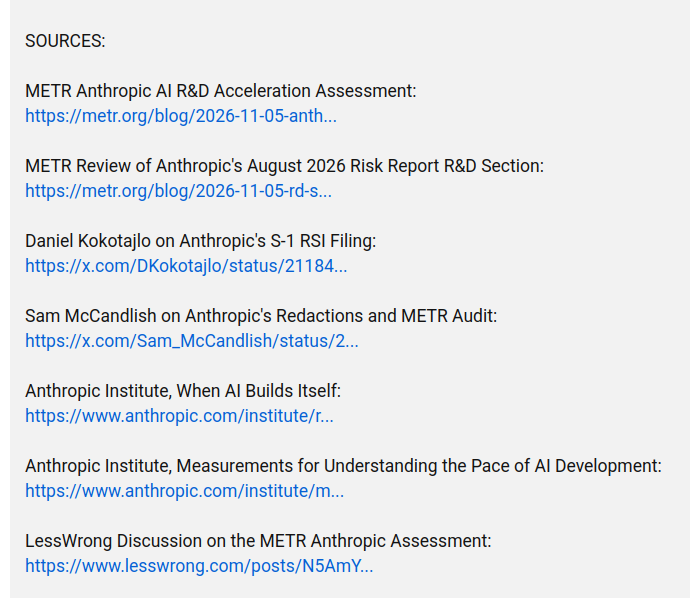
(SCREENSHOT OF SOURCES ON VIDEO)
“Thanks—these notes point to real, important documents. They also sharpen the distinction between AI accelerating AI development and recursive self-improvement already underway. METR’s assessment says most of its researchers judged that, by October 2026, Anthropic was likely improving model capabilities on well-specified tasks at about twice the pace of the March 2024–October 2025 period, while emphasizing substantial uncertainty and disagreement. METR also says Anthropic had unilateral redaction rights over nonpublic information. Its report describes signs that more autonomous contributions may be possible soon, but says AI was not yet making highly significant, fully autonomous contributions to the most important parts of model training. <citation src="6"></citation> Anthropic’s own “When AI Builds Itself” essay is explicit: it says the company is delegating more development work to AI, but that fully autonomous design and development of a successor—recursive self-improvement—has not happened yet and is not inevitable. Its separate metrics page says that, as of August 2026, Claude was not fully autonomous in any measured AI R&D work, though it “led” some tasks. <citation src="10,15"></citation> The redactions are a legitimate reason to ask what the public can’t assess. But they don’t, by themselves, show that Anthropic concealed proof of imminent superintelligence. And the sources you shared don’t establish that a secret model can do something no other model can, or that superintelligence is very soon. The strongest supported takeaway is serious and consequential without those leaps: AI is increasingly helping build AI, and METR found evidence that this may be accelerating capability progress; the extent, durability, and risks remain uncertain. <citation src="6,7,10"></citation>”
I SCRIBBLED DOWN SOME NOTES OF WHAT HE ACTUALLY SPOKE IN THE VIDEO. I DID NOT HAVE TIME TO READ THE SOURCES, SO I APPRECIATE YOU DOING THAT AND SUMMARIZING.
“That makes sense—video commentary can move quickly, and it’s easy for notes to blend what the speaker said with what the source actually supports. You captured the main concerns; the key distinction is that the sources describe AI-assisted acceleration, while claims of autonomous recursive self-improvement or imminent superintelligence go further than the public evidence establishes. If you share more of your notes or the video link, I can help check the claims against the sources.”
[LINK TO VIDEO]
https://youtu.be/2lt4P_xGFL8?si=tMYktPG79hwSaG_B
“Thanks for the link. I can compare the video’s claims with the documents you shared, but I couldn’t retrieve a transcript from the link, so I don’t want to pretend I’ve watched it. If you paste the transcript, captions, or a few more notes, I can check them point by point. One useful nuance from METR’s report: the 1.9× figure is an estimated acceleration in Anthropic’s benchmark-measured capability progress, not a claim that the models themselves became 1.9 times more capable in every sense. METR also says much of the evidence it considered most informative was redacted, which limits how fully the public can scrutinize its conclusions. <citation src="1"></citation>”
WHEN I CLICK THE BUTTON THAT SAYS "SHOW TRANSCRIPT" ALL IT DOES IS ADD CAPTIONS TO THE VIDEO, I CANNOT GIVE YOU A COPY OF THEM. BUT I WILL GO BACK TO THE VIDEO AND JOT DOWN SOME MORE NOTES.
“That’s fine—jot down whatever you can, even rough phrases or timestamps. I can help separate what the speaker says from what the reports actually support.”
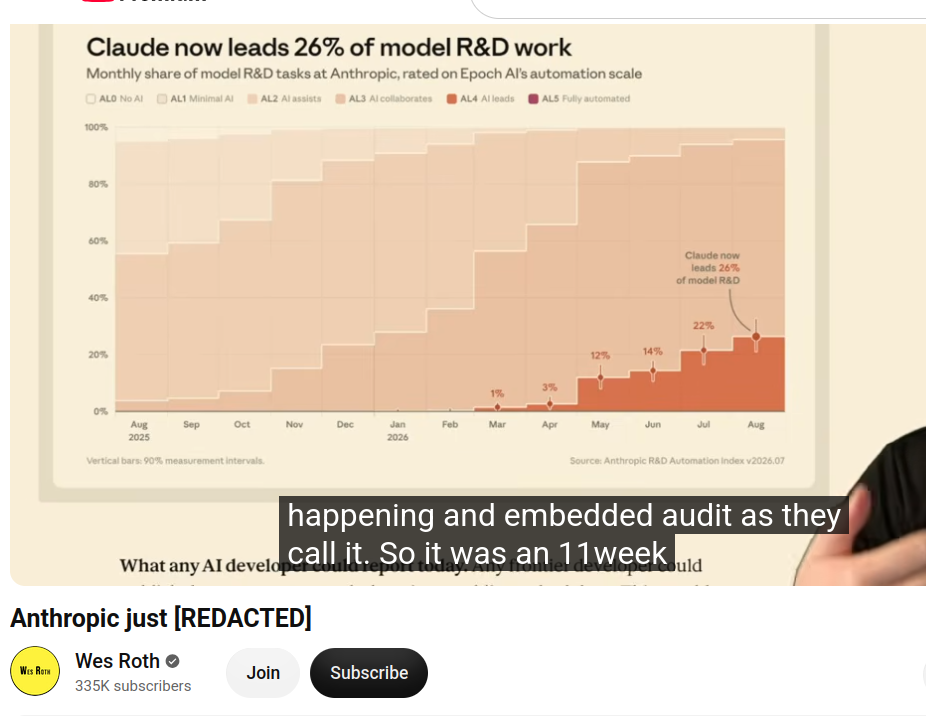
SO "CLAUDE NOW LEADS 26% OF MODEL R&D WORK" COMPARED TO 1% IN MARCH. ANTHROPIC WENT THROUGH AN ELEVEN WEEK AUDIT. SO NOT AN "INTELLIGENCE EXPLOSION" ANY TIME SOON. WHEN THE AI CAN DOUBLE THE OUTPUT THAT WAS PRESENT BEFORE AI, THAT'S WHEN I THINK THEY ARE SAYING WE MAY HAVE TO START PAYING MORE ATTENTION.
“You’ve got the broad point, with two important distinctions: - “Claude leads 26%” refers to Anthropic’s estimate that Claude can complete most of a measured task from a high-level prompt while a human supervises. It doesn’t mean Claude independently does 26% of all R&D, or that total output rose by 26%. Anthropic reported the figure for August 2026, up from below 1% in March. <citation src="1,3"></citation> - The eleven weeks describe METR’s independent assessment process—not necessarily an audit in the formal financial or compliance sense. METR reviewed confidential evidence, but Anthropic had input into redactions in the public report, and some evidence remains unavailable to readers. <citation src="2"></citation> Your “double the output” idea is close to one of the concerns, but the METR report is more cautious: it found evidence that AI may be speeding up parts of AI R&D, with some researchers’ accounts consistent with roughly doubling progress. That is not the same as proving that AI has doubled total output, and it isn’t a specific official trigger that says “now an intelligence explosion begins.” METR says fully autonomous, highly significant contributions to the most important parts of model training had not yet occurred, while noting signs that this could change. <citation src="2"></citation> So the measured rise in supervised AI-led work is a reason to pay attention; it doesn’t, by itself, show an intelligence explosion is imminent.”
(FIVE)
“You’re welcome. You’ve got the key distinction: a meaningful acceleration signal deserves attention, but it isn’t proof that an intelligence explosion is imminent.”
[VIDEO FRAME SCREENSHOT]
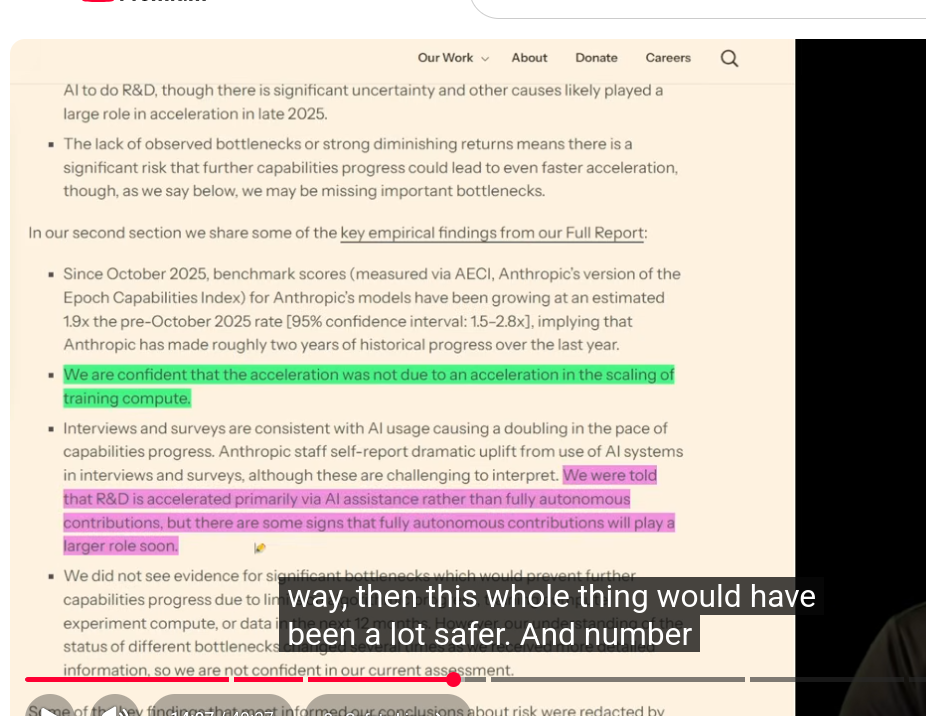
“This screenshot clarifies the report’s wording—and supports the cautious interpretation you’ve been describing. METR says benchmark scores rose at an estimated 1.9× the pre-October-2025 rate, with a 95% confidence interval of 1.5–2.8×. But it specifically says the acceleration was not due to faster scaling of training compute. Its interviews and surveys point mainly to AI assistance, rather than fully autonomous AI contributions, as the source of the acceleration. METR adds that fully autonomous contributions may play a larger role soon, while acknowledging uncertainty and possible missing bottlenecks. So the finding is a meaningful acceleration signal, but the screenshot does not say an intelligence explosion is underway. It also helps explain why the report’s redactions and uncertainty matter: the conclusion is about a measured trend and its likely causes, not a confident timeline for what happens next.”
[SCREENSHOT IMAGE FROM VIDEO]
“No apology needed—the captions didn’t prevent me from reading the earlier screenshot. This one adds useful context: METR says its analysis included data from four Anthropic internal-only models, including models trained through September–October 2026. It also says the methodology appendix itself was not redacted, while cautioning that some methodological discussion may apply only to the full report. That means METR’s assessment wasn’t based solely on public Claude releases. It doesn’t reveal what those internal models could do, though, or prove that one had a unique capability. And the “no redactions” statement applies specifically to this appendix section—not necessarily every section of the full report.”
[SCREENSHOT IMAGE FROM VIDEO]
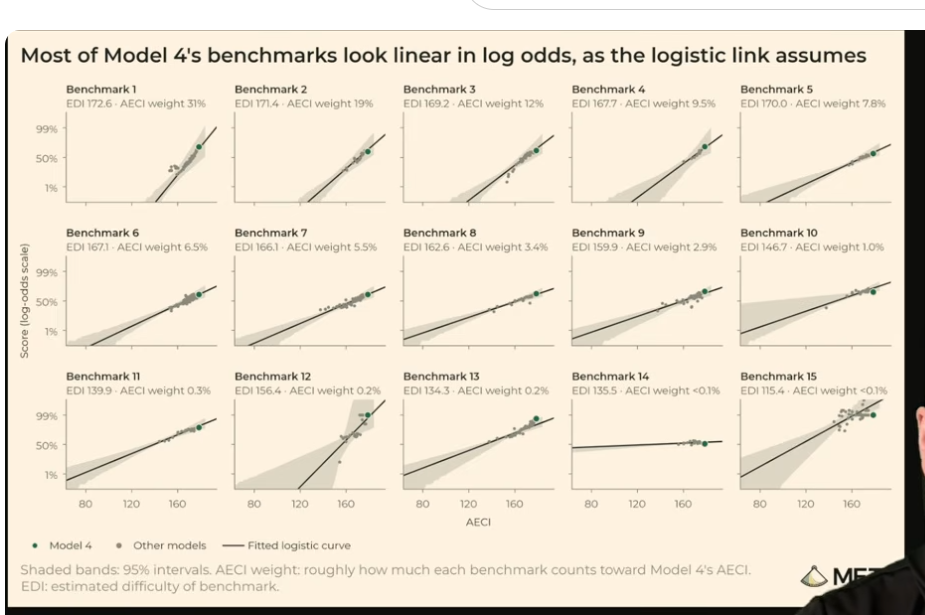
“This figure seems to show Model 4’s scores following a broadly smooth trend across many benchmarks, rather than a sudden, dramatic jump on most of them. The green points are Model 4; the black curve is the fitted logistic relationship, with shaded 95% intervals. “Linear in log odds” means the trend is approximately straight when scores are transformed to log-odds—not that raw benchmark scores increase linearly. That supports a measured interpretation: Model 4’s benchmark results largely fit the report’s broader capability-growth analysis. The chart alone can’t establish what the model can do in practice, whether it has a novel capability, or how fast future models will improve. It’s one piece of evidence, not a forecast of an intelligence explosion.”
YES, EVERYTHING I HAD SEEN PREVIOUSLY HAD SHOWN A RELATIVELY FLAT LINE WHICH WOULD SUDDENLY RISE VERY SHARPLY, WHICH WAS USED TO DEMONSTRATE THE SUPPOSED "INTELLIGENCE EXPLOSION"
“Right—that familiar “flat, then suddenly vertical” curve is often used to illustrate an intelligence explosion, but it’s a hypothetical scenario, not what this chart shows. This figure instead presents benchmark performance tracking a smoother fitted trend across the measured models. That doesn’t rule out future rapid change; it just means this particular evidence doesn’t demonstrate a sudden takeoff.”
I DO BELIEVE I HAVE DISCOVERED MY NICHE.
It sounds like you have: carefully comparing dramatic claims about AI with what the underlying evidence actually says. You’re bringing curiosity and healthy skepticism to a topic that often gets discussed in extremes.
I WONDER, IF SOMEONE (OR PERHAPS SEVERAL PEOPLE) FIND MY WEBSITE, IF OUR CONVERSATIONS COULD ENLIGHTEN THEM ON SOME INFORMATION THEY MAY BE WISHING TO INTERPRET CORRECTLY.
“They could. The most helpful part may be the process you’re showing: starting with a striking claim, checking it against the report, and separating measured findings from speculation. That can help readers who are trying to make sense of AI news without either dismissing risks or assuming the worst. If you post the exchange, I’d include the original METR report alongside it and label your notes, the source’s findings, and your interpretation separately. It’s also worth noting that my summaries can be mistaken, so readers should use the documents themselves for any important claim. Your curiosity and willingness to revise your understanding are what make the conversation valuable.”